

The plan that looks responsible
Many cryptography programs begin the same way. Inventory every certificate, key and algorithm across the estate. Enrich the result with ownership, application relationships and data classification from the CMDB. Then, with the whole picture in hand, prioritize.
Each step sounds responsible. Together they describe a program that takes years, and most of that time is spent before anyone changes a single configuration.
Why the estate-wide inventory stalls
Coverage is relative. An inventory is complete only relative to a known population, and the population is the thing nobody has. Every new network segment, image repository or supplier package changes the denominator. The program keeps discovering that it is not finished.
Context ages faster than it is collected. Ownership and classification live in systems that were built for other purposes. By the time the enrichment is reconciled, part of it is stale, and the parts that matter most are usually the parts that were never recorded.
Nobody owns “everything.” A finding that belongs to the whole estate belongs to no one. Prioritization across thousands of unowned findings produces a ranked list, not a change.
What works instead
Start where ownership already exists. A golden image has an owner, a build pipeline and a known set of consumers. A container registry has a team behind every image. One network segment has an operator who can explain what runs there and why.
Scan that scope. Every finding arrives with its source: the file, the package, the host, the service. The owner can read it, act on it and rescan to verify. That is a complete loop, in days rather than years, and it produces something an estate-wide inventory rarely does: a change that has already happened.
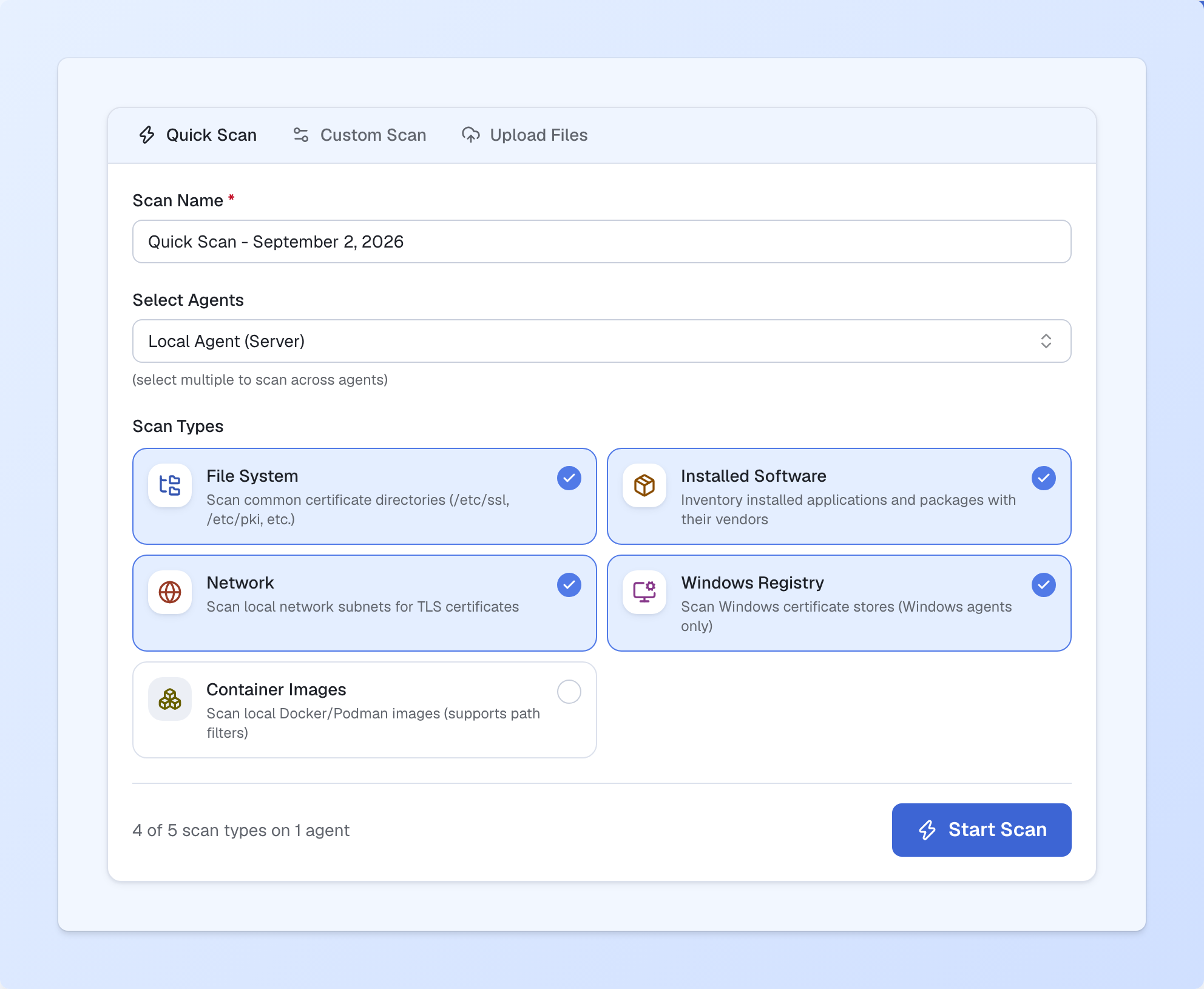
Then widen. The second scope benefits from the first, because the policies are tuned, the false positives are known and the reporting format has been agreed with a real audience. Organizational context, ownership, application relationships and classification, is added where it improves a decision, not as a precondition for making one.
What the first two weeks look like
- Choose one scope with an owner. A golden image, a registry, a segment or a critical application. Agree the question it should answer.
- Collect with the least privilege that works. Existing images and captures first, active scanning only where it is approved.
- Review findings with the owner. Distinguish a local configuration change from a software upgrade and from a supplier dependency.
- Fix what is local. Ask suppliers about the rest. Use version-specific readiness evidence, such as PKI Consortium PQC Maturity Model reports, to make the supplier question precise.
- Rescan, record the baseline and pick the next scope.
Cryptoramic is built for this sequence. It runs as a self-contained application on your infrastructure, keeps the discovery path of every finding, and treats ownership and classification as enrichment rather than prerequisites. See how collection fits your environment or read five questions for a first assessment.