
Cryptoramic

Practical scope

Five questions for your first cryptographic assessment

A focused assessment should help you make a decision, even before you have a complete inventory.

Five questions that shape a first cryptographic assessment Five connected steps: which decision, which scope, which evidence and access, who owns the result, and what happens next, ending in a verified change and the next scope. A first assessment, in five questions 1 · DecisionWhich decisionshould it inform? 2 · ScopeWhich systemsanswer it? 3 · EvidenceWhich sourcesand access? 4 · OwnerWho reviewsand acts? 5 · NextWhat is thenext step? A verified change, then the next scope rescan · record the baseline · widen What to avoid "all systems" as a scope · a report with no owner A focused assessment should support a decision before the inventory is complete.
  1. What and where?

    Identify cryptographic assets and the sources where they were observed.

  2. Who and why?

    Establish ownership, dependencies and applicable requirements.

  3. What next?

    Prioritize the changes and supplier questions that the evidence supports.

Five questions, one verified change, then the next scope.

1. Which decision should the assessment inform?

If the honest answer is “all of them”, read why an estate-wide inventory is the wrong first step before choosing a scope.
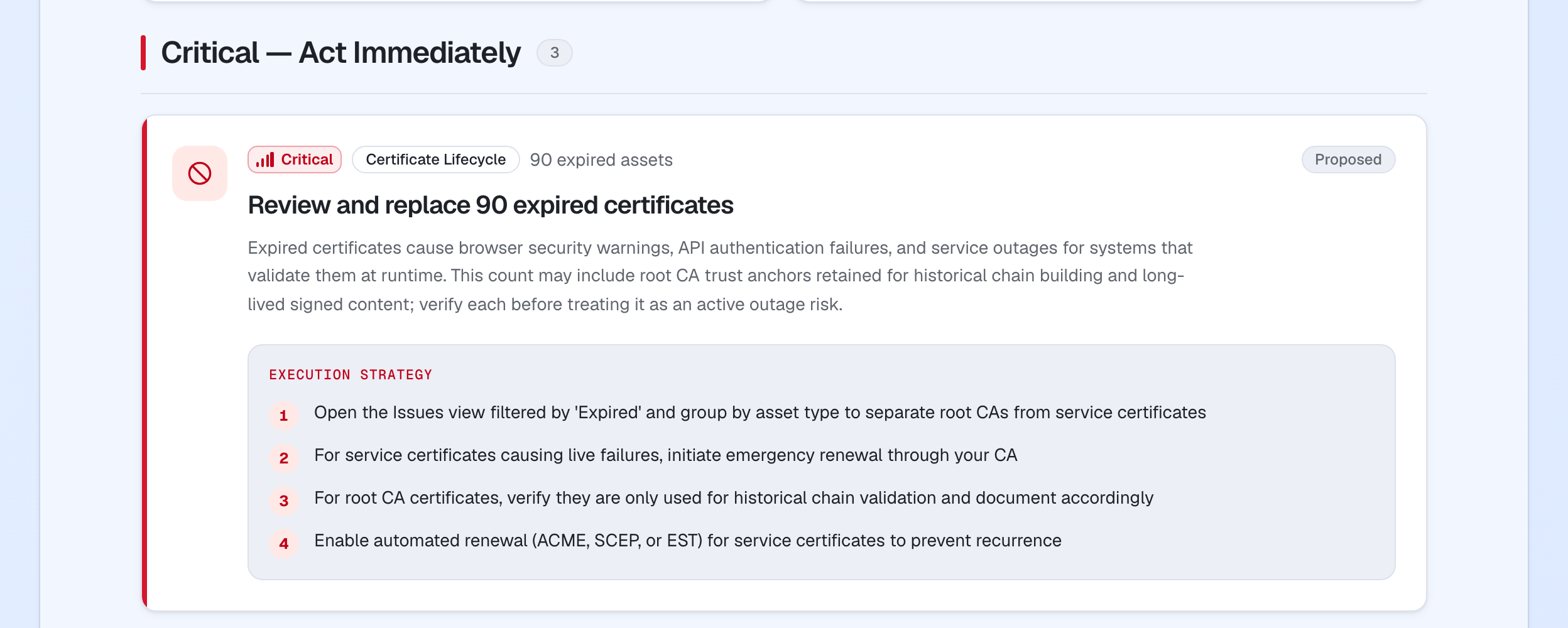
A critical action in the Cryptoramic action plan: review and replace expired certificates, with an execution strategy in four steps.
Action plan · Illustrative assessment data

Choose a concrete question. You might need to investigate an aging algorithm, understand a service’s certificates, or establish a starting point for post-quantum planning. A clear question keeps the first scope manageable.

2. What is inside the scope?

Agree which systems, files, services, and environments will be assessed. Record relevant access restrictions and exclusions. An assessment result needs those boundaries to be interpreted correctly.

3. What evidence will you need?

Think beyond a total asset count. Decide which cryptographic properties, observed locations, and relationships will help your team investigate a finding. Preserve enough context to return to the source.

4. Who can explain the findings?

Application owners and infrastructure teams understand operational context that a discovery tool may not observe. Involve them when interpreting results, identifying dependencies, and choosing follow-up actions.

5. What happens after the first assessment?

Agree how findings will be reviewed and which questions need further investigation. Plan a follow-up assessment where it can show whether relevant changes are reflected in the observed environment.

Back to perspectives

Define a first scope that answers a real question.

Discuss an assessment

Product screenshot

Illustrative assessment data